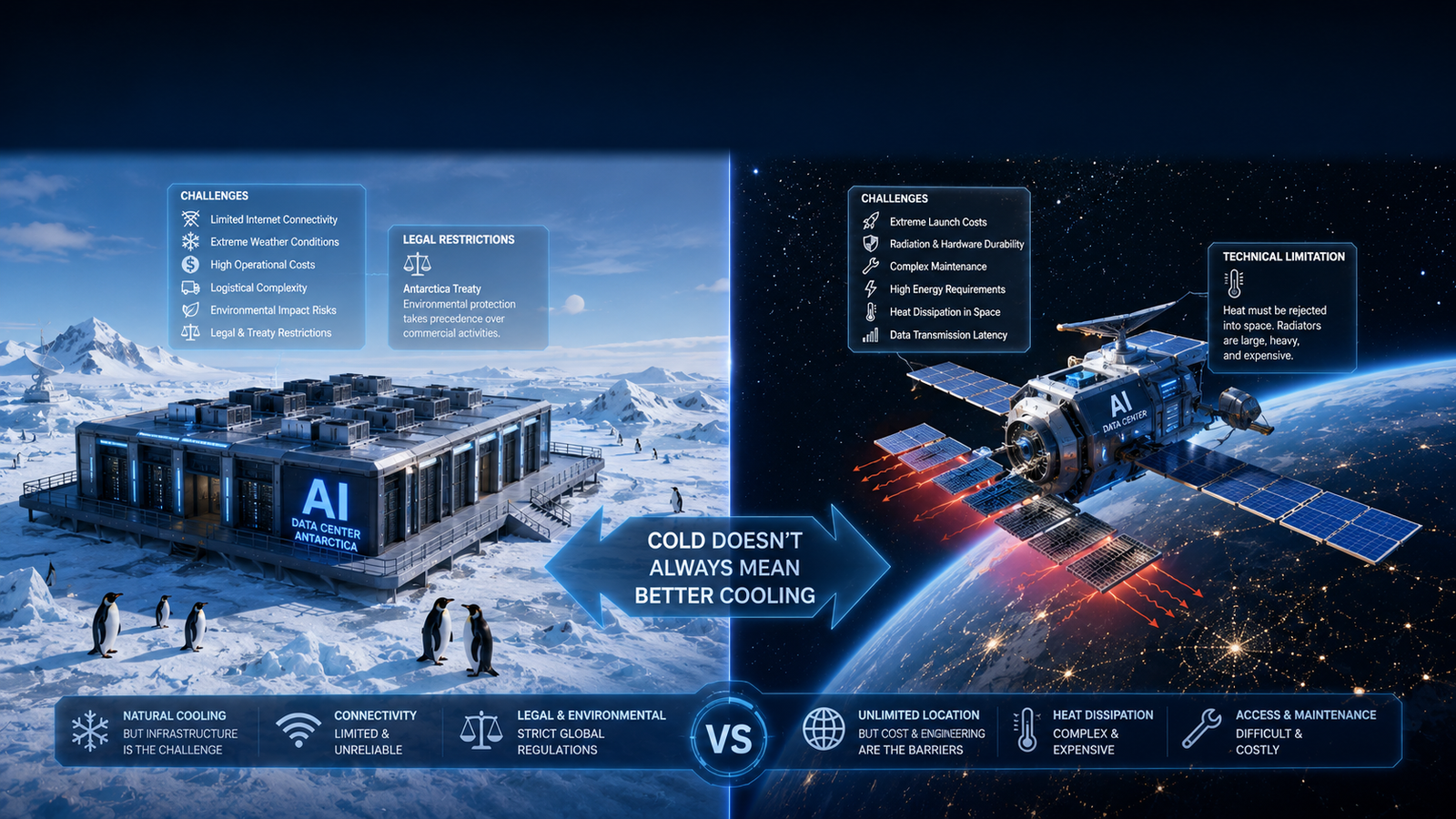
Have you ever looked at a news story about AI data centers using millions of liters of water and wondered:
“Why don’t companies just build them in Antarctica?”
After all, Antarctica is one of the coldest places on Earth.
Or maybe you’ve thought even bigger.
“Why not build data centers in space? It’s freezing cold, there’s endless sunlight for solar power, and there are no neighbors to complain about electricity usage.”
At first, both ideas sound brilliant.
But once you understand how data centers actually work, you’ll realize why companies continue building them here on Earth.
Let’s start with Antarctica.
Antarctica Sounds Perfect… Until You Look Closer
Most people think servers only have one problem: they get too hot.
That’s true—but it’s only half the story.
Modern data centers don’t simply need cold temperatures. They need stable temperatures and carefully controlled humidity.
Industry guidelines recommend keeping server environments within a controlled operating range rather than exposing them to extreme cold. If hardware becomes too cold or experiences rapid temperature changes, condensation, ice formation, and thermal stress can damage sensitive electronics.
So while Antarctica’s freezing climate might seem like free cooling, it actually creates an entirely new engineering challenge.
The Internet Is Missing
Even if engineers solved the temperature problem, another obstacle appears immediately.
A data center is only useful if people can reach it quickly.
Unlike every other continent, Antarctica has no commercial undersea fiber-optic cable connecting it to the global internet.
Research stations rely mostly on satellite communications, which are nowhere near fast or reliable enough for the massive AI workloads handled by today’s cloud providers.
Imagine trying to stream your favorite movie over an unstable internet connection.
Now imagine billions of AI requests arriving every single day.
That’s why connectivity matters just as much as cooling.
There's Another Problem Most People Forget
Even if technology wasn’t an issue, the law would be.
Antarctica isn’t owned by one country.
It’s protected by the Antarctic Treaty System, which reserves the continent primarily for peaceful scientific research and places strict limits on commercial development.
Building enormous AI data centers there would face major legal and environmental hurdles before construction could even begin.
So Antarctica isn’t impossible.
It’s simply impractical.
What About Space?
Now things get interesting.
Space seems almost perfect.
There’s almost unlimited sunlight for solar panels.
No land costs.
No weather.
No hurricanes.
No floods.
No neighbors.
It’s no surprise that several companies and researchers are seriously exploring orbital computing. Projects from companies such as Starcloud and studies from organizations including Google have shown that space-based computing is no longer just science fiction.
But here’s the catch.
Space Is Cold… But It Doesn't Cool Things
This sounds strange at first.
Space is incredibly cold, yet cooling computers there is actually harder than many people imagine.
Here’s why.
On Earth, your laptop stays cool because air moves heat away.
Liquid cooling works even better because water carries heat away much faster.
In space, there is no air.
There is no water.
Space is almost a perfect vacuum.
That means heat has only one way to escape: it must slowly radiate away as infrared energy.
To make that happen, spacecraft need large radiator panels that release heat into space. For powerful AI computers, those radiators can become enormous, adding significant weight and cost. Engineers consistently identify thermal management—not electricity—as one of the biggest technical challenges for orbital data centers.
Then Come the Space Problems
Even if engineers solve cooling, space introduces a whole new list of challenges.
Cosmic radiation can gradually damage electronic components.
Satellites repeatedly move between sunlight and Earth’s shadow, causing constant temperature changes that stress hardware over time.
If a server fails inside a building on Earth, a technician can replace it in minutes.
If the same server fails hundreds of kilometers above Earth, repairs become far more complicated and expensive.
And then there’s the biggest challenge of all:
Getting the hardware into orbit in the first place.
Launching thousands of tons of servers, cooling systems, and solar panels is still incredibly expensive, even though rocket launches are becoming cheaper every year. Many researchers believe launch costs must fall dramatically before large orbital data centers can become economically competitive.
So... Could It Ever Happen?
Surprisingly, the answer isn’t “never.”
It’s “not yet.”
Researchers, space companies, and major technology firms are actively exploring the idea because future advances in reusable rockets, on-orbit servicing, thermal engineering, and solar power could eventually make space-based computing practical.
Today, however, Earth still offers something space can’t easily match:
Fast internet, easier maintenance, lower costs, and a mature infrastructure that already supports billions of users.
So while the dream of AI data centers floating above our planet is fascinating, the biggest challenges aren’t about finding cold places.
They’re about overcoming the laws of physics.
Final Thoughts
At first glance, Antarctica and space seem like the perfect homes for AI data centers.
One is covered in ice.
The other is colder than anything on Earth.
But cooling isn’t just about temperature—it’s about how heat moves.
And in both Antarctica and space, the challenges extend far beyond simply keeping computers cold.
The next time you hear someone ask, “Why don’t we just build AI data centers in Antarctica or space?”, you’ll know the answer.
Sometimes, the simplest ideas turn out to be the hardest to engineer.
Quick Summary
Key Takeaways
- Antarctica sounds ideal for data centers, but extreme cold creates engineering problems instead of solving them.
- Antarctica has no commercial undersea internet cable and strict legal protections that limit commercial construction.
- Space offers abundant solar energy, but cooling computers there is surprisingly difficult because heat can only escape through radiation.
- Companies such as Starcloud and Google are researching orbital computing, but the technology is still experimental.
- For the foreseeable future, Earth remains the most practical place to build large AI data centers.
FAQs
1. Why can't AI data centers simply be built in Antarctica?
At first glance, Antarctica seems like the perfect place because of its freezing temperatures. However, modern data centers need stable temperature and humidity, not just cold weather.
Antarctica also lacks commercial undersea fiber-optic internet connections, making it difficult to support the massive amount of data that AI systems process every second. On top of that, the Antarctic Treaty System places strict limits on commercial development, making large-scale AI infrastructure legally and environmentally challenging.
2. Wouldn't space naturally cool computers?
Surprisingly, no.
Space is extremely cold, but it is also a vacuum. Since there is no air or water in space, computers cannot lose heat through normal cooling methods like fans or liquid cooling.
Instead, spacecraft must release heat through thermal radiation, which requires large radiator panels and careful engineering. This is one of the biggest reasons why space-based data centers remain difficult to build today.
3. Are companies actually planning to build data centers in space?
Yes.
Several companies and research groups are actively exploring the idea.
Projects such as Starcloud, Google’s Project Suncatcher, and startups like Orbital are investigating whether AI computing can eventually move into low Earth orbit. However, these projects are still in the testing or early development stage and are far from replacing traditional data centers on Earth.
4. What are the biggest challenges of space-based data centers?
Building an orbital data center involves much more than launching servers into space.
Some of the biggest challenges include:
- Removing heat without air or water.
- Protecting hardware from cosmic radiation.
- Repairing failed equipment in orbit.
- Launching thousands of tons of hardware at an affordable cost.
- Maintaining fast, reliable communication with Earth.
These engineering and economic hurdles are why experts believe Earth-based data centers will remain the primary choice for years to come.
5. Could space data centers become reality in the future?
Possibly.
Many experts believe that falling launch costs, reusable rockets, better thermal systems, and improved space infrastructure could make orbital computing more practical over the coming decades.
However, today’s technology still makes Earth-based data centers faster, cheaper, easier to maintain, and more reliable for most AI workloads.