Have you noticed something lately?
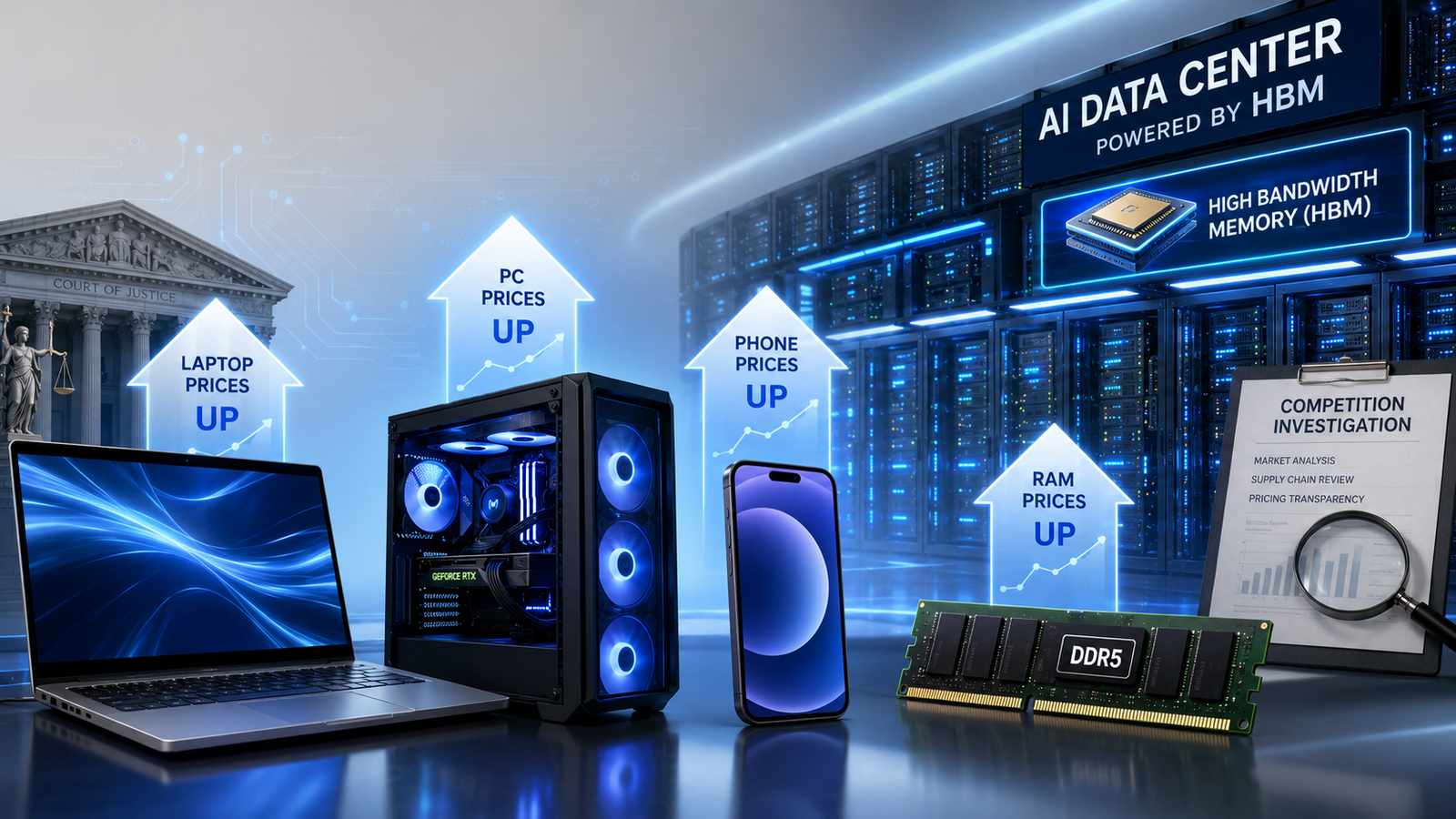
Buying a new laptop, gaming PC, or even a smartphone feels much more expensive than it did a few years ago.
Most people assume it’s because of inflation.
Others blame artificial intelligence.
While both of those play a role, a new lawsuit filed in California suggests there could be another reason hiding behind the scenes.
The lawsuit accuses three of the world’s biggest memory manufacturers – Samsung, SK hynix, and Micron – of working together to limit the supply of DRAM (the memory used in most computers and phones), causing prices to rise dramatically. It’s an allegation, not a proven fact, but if the claims are true, the impact could be felt by millions of consumers around the world.
First, What Is RAM?
Before we talk about the lawsuit, let’s understand one simple thing.
RAM, or Random Access Memory, is the short-term memory inside your phone, laptop, or desktop computer.
Think of it like your study table.
The bigger the table, the more books and notebooks you can keep open at the same time.
Similarly, the more RAM your device has, the more apps and tasks it can handle smoothly.
Almost every modern electronic device depends on DRAM (Dynamic Random Access Memory), making it one of the most important components in consumer technology.
So Why Are Prices Going Up?
Over the last few years, demand for AI has exploded.
Powerful AI systems don’t rely only on regular memory. They require a much faster type called High Bandwidth Memory (HBM).
HBM is used in AI servers and advanced graphics processors, and it sells for much higher prices than standard consumer memory.
Because of this, memory manufacturers have invested heavily in producing HBM to meet growing AI demand. On its own, that’s a normal business decision.
The lawsuit, however, claims something more serious happened.
According to the complaint, Samsung, SK hynix, and Micron didn’t just produce more HBM—they also reduced the supply of conventional DRAM used in everyday consumer devices. The plaintiffs argue that this helped drive memory prices sharply higher.
Why Is This Lawsuit Getting So Much Attention?
Here’s what makes the case unusual.
The three companies together produce around 90–95% of the world’s DRAM.
In a competitive market, rising prices usually encourage manufacturers to increase production.
More supply often brings prices back down.
But the lawsuit alleges that all three companies reduced supply around the same time instead of competing with each other.
The plaintiffs argue this behavior makes little economic sense unless there was coordination between the companies. That allegation is now at the center of the case, but it has not been proven in court.
This Isn't the First Time the Industry Has Faced These Questions
If this story sounds familiar, there’s a reason.
In the early 2000s, several major DRAM manufacturers—including Samsung, SK hynix, and Micron—were investigated over an international DRAM price-fixing cartel.
The investigation resulted in guilty pleas from multiple companies, hundreds of millions of dollars in criminal fines, and prison sentences for some executives. Micron received immunity in part because it cooperated with investigators.
That history doesn’t prove today’s allegations are true.
But it explains why this new lawsuit is receiving so much attention.
What Does This Mean for You?
Whether or not the lawsuit succeeds, one thing is already clear:
Memory has become one of the most valuable resources in the AI era.
As more manufacturers focus on supplying AI data centers, consumers could continue seeing higher prices for products like:
- Laptops
- Gaming PCs
- Smartphones
- Tablets
- Desktop computers
For anyone planning to buy a new device, memory prices are becoming an increasingly important part of the final cost.
Final Thoughts
It’s easy to look at a higher laptop price and blame inflation or AI.
But sometimes the real story is much more complicated.
The lawsuit against Samsung, SK hynix, and Micron doesn’t prove that anyone broke the law. It simply raises important questions about how one of the world’s most essential technology markets operates.
As the case moves through the courts, we’ll learn whether these allegations are supported by evidence or whether the companies decisions were simply a response to booming AI demand.
For now, the biggest takeaway is this:
When you pay more for a phone, laptop, or gaming PC today, you’re not just paying for better technology.
You’re also paying for the changing economics of the global memory industry.
Quick Summary
Key Takeaways
- RAM prices have increased significantly over the past few years.
- A California class-action lawsuit alleges Samsung, SK hynix, and Micron coordinated to restrict DRAM supply.
- The companies deny wrongdoing, and the allegations have not been proven in court.
- AI’s rapid growth has also increased demand for High Bandwidth Memory (HBM), creating genuine pressure on the memory market.
- Whether prices were driven by normal market forces, illegal coordination, or a combination of both will ultimately be decided through the legal process.
FAQs
1. Why are RAM prices increasing in 2026?
There isn’t one single reason.
Memory prices have been rising because demand has increased significantly, especially from the AI industry. At the same time, a new class-action lawsuit alleges that Samsung, SK hynix, and Micron intentionally restricted the supply of conventional DRAM, which, if proven, could have pushed prices even higher. The companies have not been found liable, and the allegations remain before the court.
2. What is HBM, and why is everyone talking about it?
HBM (High Bandwidth Memory) is a much faster type of memory used in AI servers and powerful graphics processors.
Unlike the RAM inside most laptops or desktop PCs, HBM is designed for demanding AI workloads that process huge amounts of data every second.
Because HBM is more expensive and profitable, manufacturers have invested heavily in producing it as AI demand has grown.
3. Does this lawsuit prove Samsung, SK hynix, and Micron fixed RAM prices?
No.
The lawsuit contains allegations, not proven facts.
The plaintiffs claim the companies coordinated to reduce DRAM supply and increase prices, but the court has not ruled on those claims. Until then, all three companies are presumed not to have violated the law.
4. Will laptop and smartphone prices continue to rise?
Memory is one of the most important components inside modern electronics.
If DRAM prices remain high, manufacturers may continue passing some of those costs to consumers through more expensive laptops, gaming PCs, smartphones, and tablets.
However, pricing also depends on many other factors, including processors, storage, shipping costs, tariffs, and market competition.
5. Should consumers wait before buying a new laptop or PC?
It depends on your needs.
If your current device still performs well, waiting may give you more options as the market evolves.
But if you need a new computer for work, school, or gaming, it may not be worth delaying, since analysts expect memory prices to remain elevated for some time while AI demand stays strong.