Imagine you own one of the world’s most secure houses.
Every door has smart locks.
Every window has security sensors.
There are cameras everywhere.
Now imagine a thief doesn’t try to break into your house at all.
Instead, they break into your neighbor’s house—the one that shares a gate with yours.
That, in simple words, is how many modern cyberattacks work.
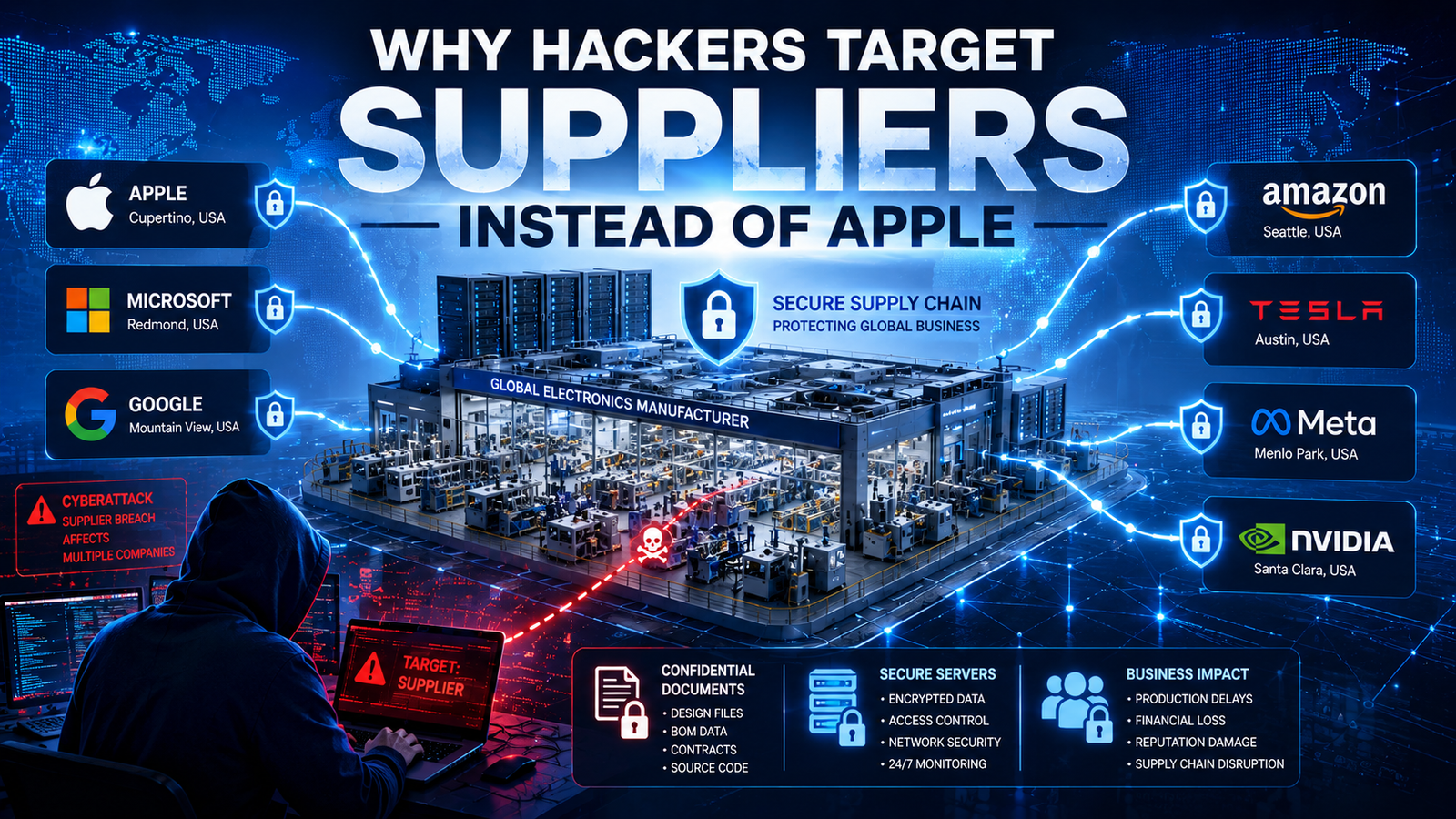
Instead of attacking companies like Apple directly, hackers often look for an easier target: their suppliers.
That’s exactly why the recent cyberattack on Tata Electronics has caught the attention of the global technology industry.
It wasn’t just another company that was hacked.
It was one of Apple’s fastest-growing manufacturing partners and a supplier that also works with companies like Tesla. When a supplier is compromised, the effects can spread far beyond a single organization.
What Happened?
Tata Electronics recently confirmed that it experienced a cybersecurity incident affecting some of its internal systems.
Soon after, a ransomware group known as World Leaks claimed responsibility for the attack.
According to Reuters, the group published more than 200,000 files, totaling around 630 GB, on its dark web leak site after an alleged extortion attempt.
Tata said it activated its incident response procedures immediately and stated that the incident did not disrupt its manufacturing operations. The company also hired an external cybersecurity consultant to carry out a forensic investigation.
Why Is This Leak Such a Big Deal?
At first, you might think,
“Companies get hacked all the time. What’s different here?”
The answer lies in what was reportedly exposed.
Security researchers and Reuters reviewed samples of the leaked data and found documents linked to several global technology companies.
Among the reported files were:
- Apple manufacturing documents.
- Component specifications.
- Supplier information.
- Factory process documents marked “Proprietary and Confidential.”
- Engineering-related Tesla documents.
- Employee records, including some passport copies.
Not every file has been independently verified, but the presence of confidential Apple manufacturing material has raised serious concerns because Apple closely guards its supply chain and product development process.
Why Don't Hackers Just Attack Apple?
This is probably the most interesting part of the story.
Most people assume hackers always go after the biggest company.
In reality, they often go after the easiest way in.
Think about an airport.
Even if the terminal has world-class security, baggage handling companies, food suppliers, cleaning contractors, and software vendors all connect to the same ecosystem.
A weakness in any one of those partners can create opportunities for attackers.
The technology industry works in much the same way.
Apple designs its products, but thousands of suppliers around the world manufacture components, assemble devices, test hardware, and manage logistics.
That means protecting the supply chain isn’t just Apple’s responsibility.
Every partner handling sensitive information becomes part of the security chain.
Cybersecurity experts call this a supply-chain attack—where attackers target a trusted partner instead of the primary company itself.
And in recent years, these attacks have become one of the fastest-growing cybersecurity threats worldwide.
Why Tata Electronics Matters So Much
This story isn’t important simply because Tata was attacked.
It’s important because of what Tata Electronics represents today.
Over the past few years, Apple has been steadily expanding manufacturing in India as part of its broader strategy to diversify production beyond China.
Tata Electronics has become one of the company’s most important partners in that effort.
Industry estimates suggest India is on track to manufacture roughly one-quarter of the world’s iPhones this year—a remarkable increase compared with just a few years ago.
That makes Tata Electronics more than just another supplier.
It has become a critical part of Apple’s global manufacturing network.
When a company at the center of such an important supply chain experiences a cybersecurity incident, it naturally attracts worldwide attention—not only from Apple but from governments, security researchers, customers, and other manufacturers.
Who Is Behind the Attack?
According to cybersecurity researchers, the group claiming responsibility calls itself World Leaks.
While the name may sound new, many researchers believe it is closely linked to or a rebranded version of the ransomware group Hunters International because both groups appear to use similar infrastructure and techniques.
Unlike older ransomware gangs that focused mainly on locking victims out of their systems, many modern cybercriminals follow a different strategy.
They quietly enter a company’s network.
They copy valuable information.
Then they threaten to publish it unless a ransom is paid.
This method is often called double extortion.
Even if a company has good backups and restores its systems, the stolen files can still be leaked publicly, putting enormous pressure on the victim.
For many organizations, protecting confidential information has become just as important as keeping their systems online.
Why Do Hackers Care So Much About Suppliers?
Imagine you’re trying to steal the blueprint for a new smartphone.
Breaking into Apple’s internal network would likely be extremely difficult.
But what if one of Apple’s manufacturing partners has copies of those same documents?
That partner may become the easier target.
This is exactly why suppliers have become attractive to cybercriminals.
Large technology companies depend on hundreds—sometimes thousands—of manufacturers, logistics firms, software providers, and engineering partners spread across the world.
Each partner stores at least some sensitive information.
If even one company in that chain is compromised, attackers may gain access to valuable documents that were never meant to leave secure systems.
In cybersecurity, this is known as a supply-chain attack, and experts consider it one of the fastest-growing risks facing modern businesses.
What Happened After the Breach?
Following the incident, Tata Electronics activated its cybersecurity response procedures and said its manufacturing operations continued without disruption.
The company also hired an independent global cybersecurity consultant to conduct a forensic investigation and reported the incident to the relevant government authorities.
According to Reuters, Apple has been working closely with Tata Electronics as investigators try to understand exactly what information may have been exposed and how the attackers gained access. India’s Computer Emergency Response Team (CERT-In) is also involved in the investigation.
At the time of writing, investigators are still examining the full scope of the breach, and some of the leaked material has not been independently verified.
Does This Mean India's Manufacturing Industry Is at Risk?
Not necessarily.
Cyberattacks affect companies across the world, including some of the biggest names in technology.
Over the past few years, organizations in North America, Europe, and Asia have all experienced major security incidents despite investing heavily in cybersecurity.
So this breach should not be viewed as evidence that one country’s manufacturing industry is insecure.
Instead, it highlights a much broader reality:
As countries become more important in global technology supply chains, they also become more attractive targets for cybercriminals.
India’s role in electronics manufacturing has grown rapidly, especially as companies diversify production beyond China.
With that growth comes greater responsibility to protect valuable intellectual property, customer data, and manufacturing systems.
The Bigger Lesson
It’s easy to think this story is only about Tata Electronics.
In reality, it’s about every company connected to a global supply chain.
Today, cybersecurity isn’t just about protecting your own servers.
It’s about protecting the trust that other companies place in you.
A single weak link can expose confidential information belonging to dozens of partners.
That’s why modern businesses increasingly evaluate cybersecurity not as an IT expense but as a business necessity.
The stronger your digital defenses are, the stronger your reputation becomes.
Final Thoughts
The Tata Electronics incident is a reminder that cyberattacks have changed dramatically.
Hackers are no longer interested only in shutting systems down.
They’re after something far more valuable: Data.
Whether it’s product designs, engineering documents, supplier information, or employee records, stolen data can be used for extortion, competitive intelligence, or sold through underground networks.
At the same time, it’s important to separate verified facts from online speculation.
Tata Electronics has confirmed a cybersecurity incident.
Researchers have identified a large cache of files published by the group calling itself World Leaks.
Authorities in India are investigating the breach, while Tata and its partners continue their forensic analysis.
The complete picture may take weeks—or even months—to emerge.
But one lesson is already clear.
In today’s interconnected world, a company’s cybersecurity is no longer just its own responsibility.
It’s a responsibility shared across the entire supply chain.
Quick Summary
Key Takeaways
- Tata Electronics confirmed a cybersecurity incident affecting some of its systems.
- The hacker group World Leaks claimed responsibility and published more than 200,000 files on the dark web.
- Some leaked documents reportedly relate to Apple, Tesla, Qualcomm, and TSMC, though investigators continue to verify the complete dataset.
- The incident highlights the growing threat of supply-chain cyberattacks, where hackers target suppliers instead of attacking large technology companies directly.
- As global manufacturing becomes more interconnected, cybersecurity is becoming a shared responsibility across the entire supply chain.
FAQs
1. What happened in the Tata Electronics cyberattack?
Tata Electronics confirmed that it experienced a cybersecurity incident affecting some of its internal systems. Shortly afterward, the ransomware group World Leaks claimed it had stolen and published more than 200,000 files (around 630 GB) on the dark web. The leaked data reportedly included documents related to Apple, Tesla, and other technology companies. Tata stated that its manufacturing operations were not disrupted and launched a forensic investigation.
2. Why do hackers attack suppliers instead of companies like Apple?
Large companies such as Apple invest heavily in cybersecurity, making them difficult targets.
Suppliers, however, often store sensitive manufacturing documents, engineering files, and confidential business information while working with multiple global companies.
By attacking one supplier, hackers may gain access to information connected to several major organizations at once. This type of attack is known as a supply-chain attack, and cybersecurity experts consider it one of the fastest-growing threats in modern business.
3. Did the hackers really steal Apple and Tesla documents?
According to Reuters, security researchers reviewed samples of the leaked files and found documents linked to Apple and Tesla, including manufacturing specifications and confidential engineering material.
However, Reuters also noted that not every leaked file has been independently verified, so investigators are still determining the full scope of the breach.
4. Who is World Leaks?
World Leaks is a cybercriminal group that claimed responsibility for the Tata Electronics breach.
Many cybersecurity researchers believe it is closely connected to, or a rebranded version of, the ransomware group Hunters International, based on similarities in its infrastructure and methods.
Like many modern ransomware groups, World Leaks appears to focus on stealing confidential data first and then demanding payment to prevent public disclosure.
5. What can companies learn from this incident?
The biggest lesson is that cybersecurity is no longer just about protecting your own company.
Organizations must also secure every part of their supply chain because confidential information often moves between manufacturers, suppliers, software vendors, and logistics partners.
One weak link can expose sensitive data belonging to many different companies, making supply-chain security just as important as internal security.