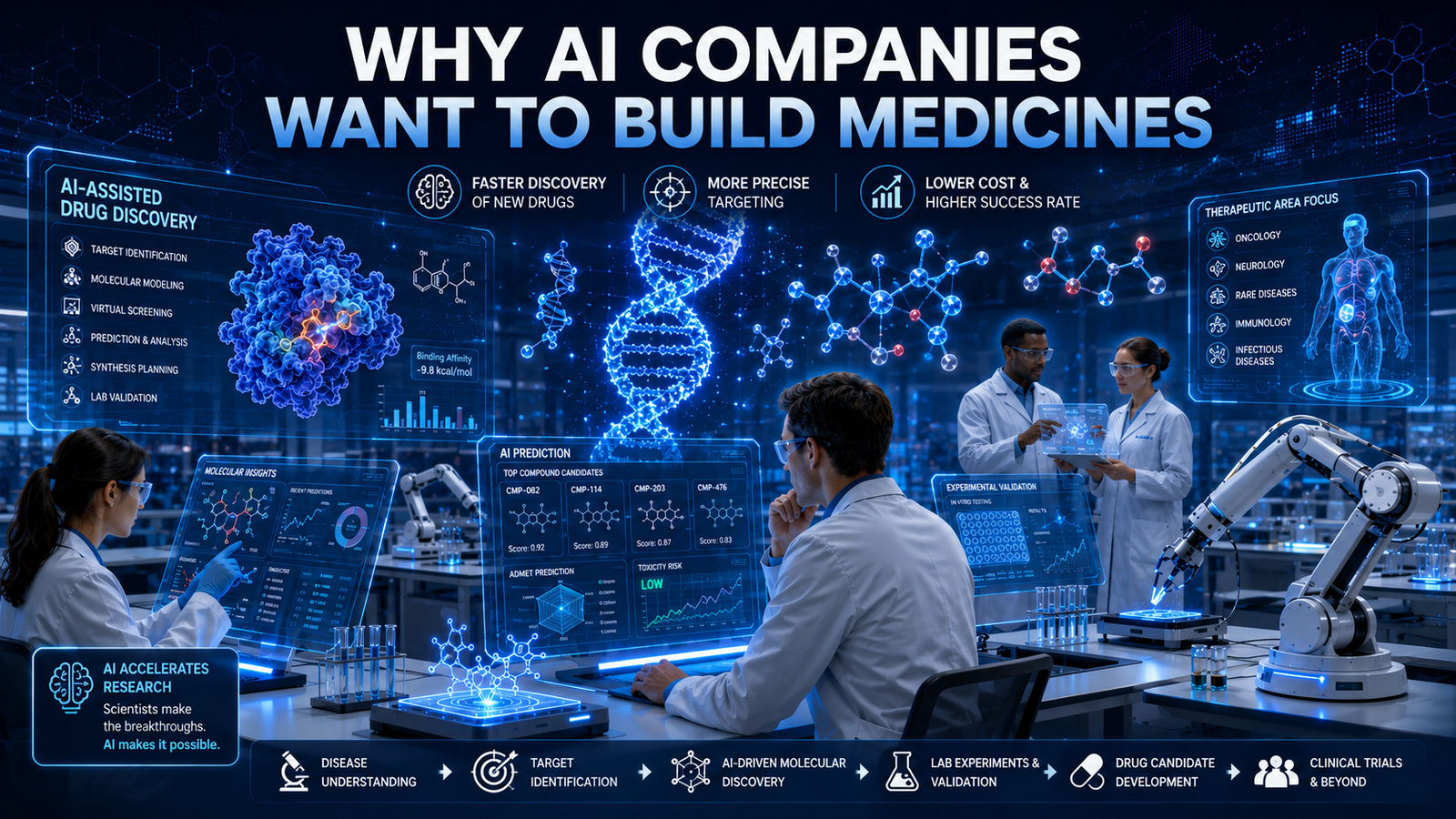
For the past few years, most people have seen AI as a tool for writing emails, generating images, or helping programmers write code.
But something much bigger is beginning to happen.
Some of the world’s leading AI companies are now looking beyond chatbots and software. They want to help discover new medicines.
Recently, Anthropic announced Claude Science, a specialized AI platform designed to help scientists analyze research, manage complex workflows, and accelerate scientific discovery. But the announcement didn’t stop there.
The company also revealed something that surprised many people:
It wants to develop its own medicines, beginning with diseases that have historically received less attention because they affect smaller populations or generate lower commercial returns.
That raises an interesting question.
Are AI companies simply building better research tools?
Or are they slowly becoming the next generation of pharmaceutical companies?
Why Drug Discovery Is So Important
Creating a new medicine isn’t as simple as mixing chemicals in a laboratory.
Scientists often spend years trying to understand how proteins behave, how diseases affect the body, and which molecules might safely treat an illness.
The process is incredibly expensive.
Many medicines take more than a decade to develop, and only a small percentage ever make it through clinical trials and regulatory approval.
This is exactly where AI can help.
Instead of replacing scientists, AI can analyze enormous amounts of biological data, identify hidden patterns, compare millions of molecular structures, and suggest promising candidates for researchers to investigate further.
In other words, AI doesn’t magically invent a cure overnight.
It helps scientists make better decisions faster.
Anthropic Isn't Alone
If this sounds like a science-fiction story, it isn’t.
Almost every major AI company is investing heavily in healthcare and life sciences.
Google DeepMind transformed biological research with AlphaFold, which predicted the structures of more than 200 million proteins—a breakthrough that dramatically accelerated research around the world. Recently, AlphaFold co-creator and Nobel laureate John Jumper announced that he is leaving Google DeepMind to join Anthropic, adding even more scientific expertise to the company’s life sciences efforts.
Anthropic has also strengthened its position by acquiring biotech startup Coefficient Bio, whose team specializes in applying AI to biological research.
Meanwhile, companies including OpenAI, Amazon, and Google are all expanding their investments in AI-powered scientific research and drug discovery.
This isn’t a competition to build better chatbots anymore.
It’s becoming a race to accelerate scientific discovery itself.
Why Pharmaceutical Companies Are Paying Attention
One of the biggest strengths of pharmaceutical companies isn’t their factories.
It’s their knowledge.
Over decades of research, drug companies have collected enormous amounts of information that isn’t publicly available.
They know which compounds failed.
Which molecules showed promise.
Which treatments caused unexpected side effects.
Which clinical trials succeeded—and why others didn’t.
That information is incredibly valuable because it represents decades of scientific research and billions of dollars in investment.
Some industry analysts believe that if pharmaceutical companies increasingly rely on external AI platforms during research, they may eventually become more dependent on those AI providers. This doesn’t mean AI companies will automatically replace pharmaceutical firms, but it has started an important conversation about who will own the most valuable scientific knowledge in the future.
The Other Side of the Story
At first glance, it might sound as though AI is about to revolutionize medicine overnight.
Reality is more complicated.
Despite billions of dollars invested in AI-driven drug discovery over the past several years, no fully AI-designed drug has yet received approval from the U.S. Food and Drug Administration (FDA).
AI can dramatically speed up early research.
But it cannot replace laboratory experiments.
It cannot replace animal studies.
It cannot replace human clinical trials.
And it certainly cannot skip years of safety testing.
In healthcare, moving faster is valuable—but moving safely is essential.
Why Start With Neglected Diseases?
One part of Anthropic’s announcement caught the attention of both scientists and the pharmaceutical industry.
Instead of saying it wanted to compete directly in blockbuster medicines, the company said it would initially focus on neglected diseases—conditions that affect millions of people but often receive less investment because developing treatments may not be commercially attractive.
On paper, that sounds like a positive goal.
Many diseases affecting lower-income countries have historically received far less research funding than conditions with larger commercial markets.
If AI can help researchers discover treatments faster and at a lower cost, patients who have long been overlooked could ultimately benefit.
But this announcement has also started a much bigger conversation.
The Question That Has the Pharma Industry Thinking
Imagine spending 20 years building a library that contains everything you’ve learned.
Every failed experiment.
Every successful molecule.
Every unexpected side effect.
Every clinical observation.
Now imagine asking an AI system to help you analyze that library every day.
Eventually, an important question begins to emerge.
Who is learning the most?
The scientist?
Or the AI company building the platform?
To be clear, there is no evidence that Anthropic or other AI companies are using customers’ confidential research to build competing medicines.
Leading AI providers have enterprise privacy policies designed to protect customer data.
However, some industry analysts believe pharmaceutical companies should think carefully about how they use external AI systems when handling highly valuable intellectual property.
The concern isn’t about today’s products.
It’s about what the relationship between AI companies and pharmaceutical companies might look like ten years from now.
Why Biology Is Different From Coding
When people hear about AI writing code or creating images, it usually feels exciting.
Biology is different.
The same AI system that helps researchers understand proteins, design medicines, or identify promising molecules could also, in theory, be misused if powerful biological knowledge fell into the wrong hands.
That’s one reason Anthropic has repeatedly emphasized biosecurity as a priority.
During the launch of Claude Science, CEO Dario Amodei explained that increasingly capable biological AI systems may eventually require trusted-access programs, allowing only verified organizations or researchers to use their most advanced capabilities.
The goal isn’t to slow scientific progress.
It’s to make sure powerful tools are used responsibly.
AI Still Can't Replace Scientists
With so much excitement around AI, it’s easy to think computers are about to replace laboratories.
They’re not.
Even if an AI system identifies a promising drug candidate in a matter of hours, researchers still have years of work ahead.
The molecule must be created.
It must be tested in laboratories.
It must pass animal studies.
Then come multiple phases of human clinical trials.
Finally, regulators must determine whether the treatment is both safe and effective.
Every one of those steps takes time.
This explains why, despite billions of dollars invested in AI-assisted drug discovery since 2019, no fully AI-designed drug has yet received approval from the U.S. Food and Drug Administration (FDA). AI is making research faster, but it is not eliminating the scientific process.
Could AI Companies Become Pharmaceutical Giants?
Right now, nobody knows.
Some experts believe AI companies will remain technology partners, building tools that help pharmaceutical companies discover medicines more efficiently.
Others think AI companies could gradually expand beyond software, eventually discovering, licensing, or even developing their own drugs.
Today’s announcements from Anthropic suggest that this possibility is no longer just science fiction.
Whether AI companies ultimately become competitors, collaborators, or something in between will depend on scientific breakthroughs, business partnerships, regulation, and public trust over the next decade.
For now, one thing is clear:
The relationship between AI and healthcare is entering a completely new chapter.
Final Thoughts
For years, AI companies built tools that helped people write faster, code better, and automate everyday tasks.
Now they’re aiming much higher.
They’re stepping into one of the most complex fields in human history: medicine.
That doesn’t mean pharmaceutical companies are about to disappear.
Nor does it mean AI will suddenly discover cures for every disease.
But it does signal an important shift.
The future of healthcare may not be shaped by pharmaceutical companies alone.
It may also be shaped by the AI models helping scientists ask better questions, analyze larger datasets, and discover promising treatments faster than ever before.
The biggest challenge won’t simply be building smarter AI.
It will be ensuring that these powerful tools remain safe, transparent, scientifically rigorous, and focused on improving patient outcomes.
If AI succeeds in doing that, its greatest contribution may not be replacing scientists—it may be helping them solve problems that once seemed impossible.
Quick Summary
Key Takeaways
- Anthropic has launched Claude Science, a research platform built for scientists.
- The company also plans to explore developing medicines, beginning with neglected diseases.
- AI is becoming an important tool for drug discovery, but it cannot replace laboratories or clinical trials.
- Pharmaceutical companies own valuable scientific knowledge that some analysts believe should be protected carefully when using external AI platforms.
- The future of medicine will likely involve collaboration between AI companies and pharmaceutical researchers rather than one replacing the other.
FAQs
1. What is AI-powered drug discovery?
AI-powered drug discovery is the use of artificial intelligence to help scientists identify promising drug candidates, analyze biological data, predict protein structures, and speed up early-stage research. AI doesn’t replace laboratories or clinical trials—it helps researchers make faster and more informed decisions.
2. What is Claude Science?
Claude Science is a specialized research platform introduced by Anthropic for scientists and researchers. It is designed to support scientific workflows, including literature analysis, computational biology, protein visualization, and drug discovery research.
3. Is Anthropic becoming a pharmaceutical company?
Not exactly.
Anthropic has announced plans to explore developing medicines, initially focusing on neglected diseases. However, it remains primarily an AI company. Whether it eventually becomes a full pharmaceutical developer will depend on future research, partnerships, clinical trials, and regulatory approvals.
4. Can AI create medicines without scientists?
No.
AI can suggest molecules, analyze research papers, and identify biological patterns much faster than humans.
However, scientists still need to:
- Validate AI’s findings
- Conduct laboratory experiments
- Perform animal studies
- Run multiple phases of clinical trials
- Obtain regulatory approval
AI is accelerating research—not replacing the scientific method.
5. Has any AI-designed drug received FDA approval?
As of now, no fully AI-designed drug has received approval from the U.S. Food and Drug Administration (FDA). While AI has become an important tool throughout drug discovery, every candidate must still complete years of testing before it can reach patients.
6. Why are AI companies investing in healthcare?
Healthcare contains enormous amounts of scientific data, making it an ideal field for AI.
Researchers hope AI can:
- Discover drugs faster.
- Reduce research costs.
- Identify promising molecules earlier.
- Improve understanding of diseases.
- Accelerate scientific breakthroughs.
Major companies including Anthropic, Google, OpenAI, and Amazon are investing heavily in this area.