For the past two years, artificial intelligence has become a global race.
Most people think the competition is only between companies like OpenAI, Google, Anthropic, and Meta. But in reality, the race is much bigger than that. Countries themselves are now competing to build the smartest AI systems, protect their technology, and reduce their dependence on others.
Now imagine waking up one morning and discovering that one of the world’s biggest AI suppliers has decided to limit access to its most powerful models.
Would that affect India?
At first glance, you might think, “Not really. We still have ChatGPT.”
But the answer is far more complicated.
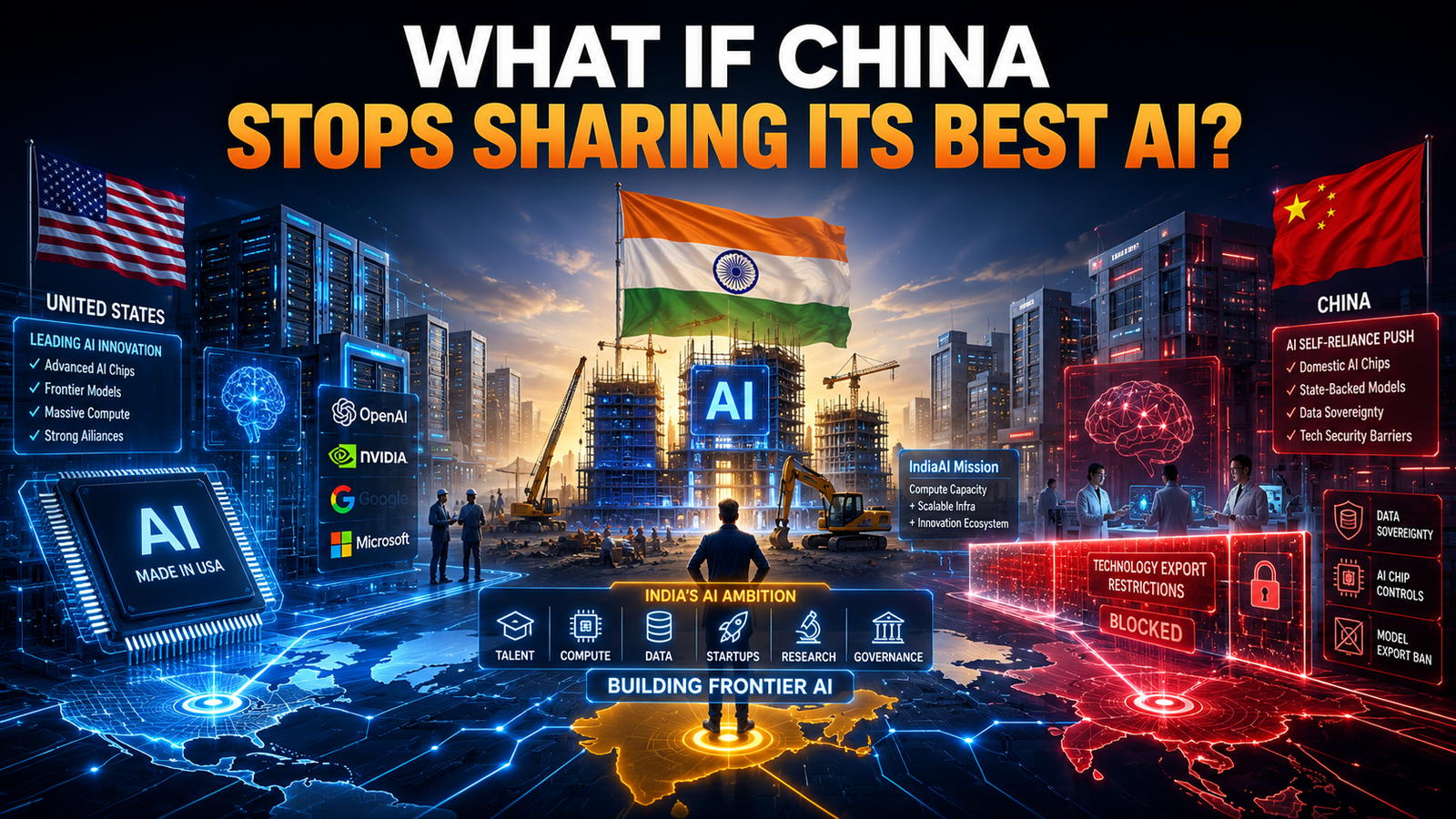
According to recent reports, Chinese officials have been discussing whether overseas access to some of China’s most advanced AI models should be restricted. These discussions reportedly involve major AI companies such as Alibaba, ByteDance, and Z.ai. No final decision has been announced, but the fact that these conversations are happening shows how seriously governments now view frontier AI.
And that’s where India enters the conversation.
AI Is Becoming a National Asset, Not Just a Product
A few years ago, AI companies wanted as many users as possible.
Today, governments are beginning to ask a different question:
“Should our most advanced AI technology be available to everyone?”
The United States has already introduced tighter controls around certain frontier AI technologies, especially those with potential national security implications. China now appears to be considering a similar approach for its own most capable models.
This isn’t because AI has suddenly become dangerous overnight.
It’s because modern AI can assist in areas like advanced scientific research, cybersecurity, software engineering, robotics, and military applications. Countries increasingly see these capabilities as strategic assets rather than ordinary software.
Think about it this way.
A decade ago, nations competed over oil and semiconductor manufacturing.
Today, they’re also competing over intelligence itself.
How China Quietly Closed the AI Gap
Two years ago, most AI experts believed American companies had a comfortable lead.
OpenAI, Anthropic, and Google were setting the pace, while Chinese companies appeared to be catching up.
Instead of trying to copy every move made by Silicon Valley, many Chinese AI developers took a different path.
They invested heavily in open-weight and open-source AI models, encouraged domestic research, and rapidly improved their own ecosystems. Academic research also suggests that U.S. export controls unintentionally accelerated China’s open AI ecosystem by encouraging greater domestic innovation.
Today, several Chinese AI models perform remarkably well across coding, reasoning, mathematics, and multilingual tasks.
Whether one model is “better” than another depends on the benchmark being measured, but there’s little doubt that China has become one of the world’s leading AI powers.
That growing capability may also explain why Chinese policymakers are becoming more cautious about sharing their most advanced technology globally.
Where Does India Stand?
This is probably the most important question for Indian readers.
India has made meaningful progress in artificial intelligence.
Projects like Sarvam AI, the IndiaAI Mission, and several university-led initiatives are helping build models designed specifically for Indian languages and local applications.
That is something worth appreciating.
Building a large language model requires enormous computing power, world-class engineering talent, and billions of dollars in infrastructure. Every serious attempt moves India’s AI ecosystem forward.
However, it’s equally important to understand the difference between regional AI models and frontier AI models.
A regional model may excel at Indian languages, government services, or education.
A frontier model pushes the limits of reasoning, scientific research, software development, and complex problem-solving on a global scale.
Today, for many of these cutting-edge capabilities, India still depends heavily on technologies developed abroad.
And that’s exactly why the discussion around China’s AI strategy matters—not because China has already restricted access, but because it reminds every country of one simple lesson:
The future belongs to nations that can build, control, and improve their own frontier AI technologies.
What Happens If Both America and China Tighten AI Access?
Now let’s think one step ahead.
For the past few years, developers around the world have enjoyed something unusual: competition between AI companies. If one model became expensive, another often emerged as a cheaper alternative. If one company restricted access, developers could usually switch to another provider.
But what happens if the world’s two biggest AI powers—the United States and China—both begin treating their frontier AI models as strategic technologies?
That question no longer sounds hypothetical.
The United States has already imposed export controls on certain advanced AI technologies, while China is reportedly considering similar restrictions on some of its most advanced models. Although the policies are different, both countries appear to be moving toward the same philosophy: the most capable AI systems are becoming matters of national security rather than ordinary software products.
If that trend continues, countries that rely entirely on foreign AI could face difficult choices.
Why This Matters for India
For India, the challenge isn’t that AI tools will suddenly disappear.
The real challenge is dependence.
Today, millions of Indian students, startups, software engineers, researchers, and businesses use AI models developed abroad. These tools power everything from coding assistants and customer support to education and scientific research.
If access becomes more expensive, more restricted, or limited to approved users, Indian companies could face higher costs and fewer options.
Fortunately, India isn’t standing still.
Government initiatives such as the IndiaAI Mission and startups like Sarvam AI are building models designed specifically for Indian languages and local use cases. These projects represent important progress toward technological self-reliance.
However, building a frontier AI model is an entirely different challenge.
It requires enormous investments in computing infrastructure, specialized AI chips, world-class researchers, high-quality datasets, and years of continuous research.
That’s why many experts believe India still has a long journey before it can compete directly with the world’s largest frontier AI laboratories.
Why China May Never Fully Close the Door
Here’s where the discussion becomes more interesting.
Some commentators believe China may never completely block overseas access to its AI models.
Why?
Because global adoption also creates influence.
Every developer who builds applications using Chinese AI models strengthens China’s position in the global AI ecosystem.
Limiting access too aggressively could reduce that influence while encouraging other countries to invest even more heavily in their own AI infrastructure.
In other words, there’s a balance to maintain.
Protecting national security is important.
But remaining globally competitive is important too.
That’s one reason why many analysts believe any future restrictions—if implemented—would likely focus on the most advanced frontier models rather than every AI system developed in China. Reuters similarly notes that discussions are centered primarily on China’s most capable current and future models rather than AI technology as a whole.
India's Biggest Opportunity
Every challenge creates an opportunity.
If this global AI competition teaches India one lesson, it’s this:
Building AI isn’t enough. Building independent AI matters even more.
India has one of the world’s largest software developer communities.
It has globally respected engineering talent, growing AI startups, expanding cloud infrastructure, and one of the largest digital populations anywhere.
Those are significant advantages.
The next step is turning those advantages into frontier innovation.
That won’t happen overnight.
But neither did today’s leading AI companies become global leaders in a single year.
Every frontier model started as an ambitious research project backed by long-term investment.
Final Thoughts
Whether China ultimately restricts overseas access to its most advanced AI models or decides against it, one thing is already clear.
Artificial intelligence is no longer just a business.
It’s becoming a strategic resource—much like semiconductors, energy, and telecommunications.
The world’s leading AI powers are increasingly thinking about technology in terms of national security, economic competitiveness, and long-term influence.
For India, this shouldn’t be viewed as a crisis.
It should be viewed as motivation.
Instead of asking whether foreign AI models will always remain available, perhaps the more important question is this:
Can India build AI powerful enough that the rest of the world wants to use it?
That may ultimately prove to be the conversation that shapes India’s technological future over the next decade.
Quick Summary
Key Takeaways
- China is considering restrictions on overseas access to some of its most advanced AI models, but no final decision has been announced.
- Both China and the United States increasingly view frontier AI as a strategic national asset.
- India has promising AI initiatives, including Sarvam AI and BharatGen, but it is still developing frontier-scale capabilities.
- Greater investment in domestic AI research could reduce long-term dependence on foreign AI technologies.
- The future AI race is no longer only about building smarter models—it’s also about technological independence.
FAQs
1. Is China banning its AI models?
No—not at the moment.
The verified reports say that Chinese authorities are discussing possible restrictions on overseas access to some of their most advanced AI models. No official ban or final policy has been announced yet.
2. Why is China considering these restrictions?
As AI becomes more powerful, countries increasingly view it as a strategic national asset, similar to advanced semiconductor technology.
According to reports, China is concerned about protecting its frontier AI capabilities, preventing technology leaks, and strengthening national security.
3. Does India have its own AI models?
Yes.
India has made important progress through initiatives like Sarvam AI, BharatGen, and the IndiaAI Mission.
However, when people discuss frontier AI, they usually mean the world’s most advanced foundation models that require enormous computing power, billions of dollars in investment, and years of research.
India is making progress, but it is still building that level of capability.
4. What is a frontier AI model?
A frontier AI model is among the most advanced AI systems available.
These models can perform complex reasoning, software engineering, scientific research, advanced mathematics, multilingual understanding, and many other sophisticated tasks.
Examples include the newest generations of models developed by major global AI laboratories.
5. Could restrictions affect Indian developers?
Potentially, yes.
If overseas access to leading AI models becomes more restricted or more expensive, Indian startups, researchers, software developers, and businesses could face higher costs or fewer choices.
That is one reason many experts believe India should continue investing in domestic AI research and infrastructure.
6. Should India build its own frontier AI?
Many technology experts believe the answer is yes.
Developing frontier AI would not only reduce dependence on foreign technology but could also strengthen India’s research ecosystem, startup economy, and long-term technological competitiveness.
Building such systems, however, requires sustained investment in talent, computing infrastructure, high-performance chips, and research.