Imagine spending billions of dollars and years of research to build one of the world’s smartest AI models.
Now imagine someone learning many of its best tricks simply by asking it millions of questions.
Sounds impossible?
According to AI company Anthropic, that’s exactly what happened.
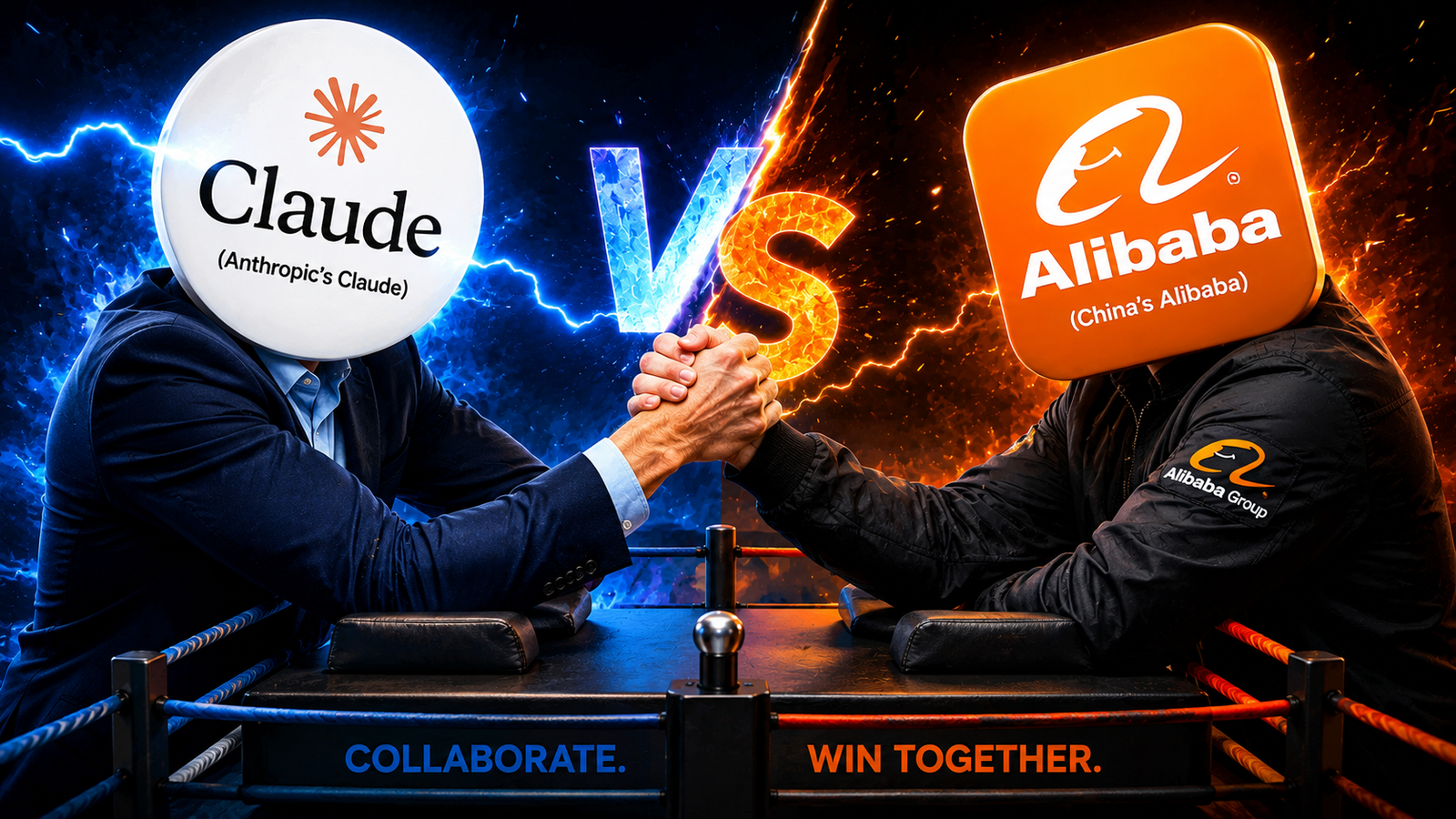
The company recently accused Chinese tech giant Alibaba of carrying out what it calls the largest AI “distillation” campaign it has ever seen. If true, it could become one of the biggest stories in the AI industry this year.
But before jumping to conclusions, let’s understand what actually happened—and why everyone is talking about it.
What Did Anthropic Claim?
Anthropic, the company behind the AI assistant Claude, says operators linked to Alibaba created nearly 25,000 fraudulent accounts and generated more than 28.8 million conversations with Claude over several weeks.
According to Anthropic, these weren’t normal chats.
The questions reportedly focused on difficult coding problems, advanced reasoning, software engineering, and long, multi-step tasks—the areas where Claude performs especially well.
Anthropic shared these allegations in a letter sent to U.S. lawmakers, arguing that the activity was designed to copy Claude’s capabilities rather than simply use the chatbot.
What Is AI Model Distillation?
The word “distillation” might sound complicated, but the idea is actually simple.
Imagine a brilliant teacher solving thousands of difficult problems.
A student watches every answer, studies the patterns, and gradually learns to solve similar problems on their own.
That’s essentially how AI model distillation works.
Instead of copying the original model’s source code, developers train a new model using the answers produced by a more advanced AI.
In many situations, distillation is a completely legitimate technique used by AI companies on their own models to create smaller, faster, and cheaper versions.
The controversy begins when companies allegedly use another company’s AI without permission to train their own systems. That’s what Anthropic says happened here.
Why Does This Matter?
Training a frontier AI model isn’t cheap.
It requires enormous computing power, massive datasets, and years of engineering work.
If another company can learn from millions of responses generated by that model, it may reduce some of the time and cost needed to improve its own AI.
That’s why Anthropic describes these large-scale extraction efforts as a serious threat to intellectual property and future AI development.
The Debate Isn't Black and White
Here’s where the story becomes interesting.
Some people argue that if an AI model publicly answers questions through an API, learning from those answers is simply another form of research.
Others believe that collecting millions of responses to reproduce a competitor’s capabilities crosses an ethical—and possibly legal—line.
At the time of writing, these are allegations made by Anthropic, and the broader legal and regulatory questions around AI model distillation are still evolving.
What Can We Learn From This?
Whether you’re an AI developer, student, creator, or business owner, this story highlights an important reality.
Today’s AI race isn’t just about building smarter models.
It’s also about protecting them.
As AI becomes more capable, companies will likely invest more in security, monitoring, and abuse detection to prevent large-scale extraction of their models’ capabilities.
At the same time, governments around the world are paying closer attention to how advanced AI technologies are developed, shared, and protected.
Final Thoughts
The biggest takeaway isn’t that AI companies are fighting each other.
It’s that AI has become valuable enough for companies to compete fiercely over knowledge itself.
Anthropic’s allegations against Alibaba remind us that in today’s AI race, data, model capabilities, and innovation are just as valuable as physical assets.
Whether these allegations ultimately lead to legal action or industry-wide changes remains to be seen.
But one thing is already clear:
The next chapter of artificial intelligence won’t be decided only by who builds the smartest AI.
It will also be shaped by how those models are protected, shared, and used responsibly.
FAQs
1. What is AI model distillation?
AI model distillation is a technique where a smaller AI model learns from the responses of a more advanced AI model instead of learning directly from raw training data.
It’s important to understand that distillation itself isn’t illegal. In fact, many AI companies use it internally to create faster and cheaper versions of their own models.
The controversy begins when one company allegedly uses another company’s AI without permission to improve its own models at scale. Anthropic claims this is what happened with Claude.
2. Did Alibaba really create 25,000 fake accounts?
According to Anthropic, yes.
The company alleges that operators linked to Alibaba and its Qwen AI lab created nearly 25,000 fraudulent accounts and generated more than 28.8 million conversations with Claude between April and June 2026.
However, these are currently allegations made by Anthropic. Alibaba had not publicly responded to these specific claims when the initial reports were published.
3. Why is this a big deal for the AI industry?
Modern AI models cost hundreds of millions—or even billions—of dollars to develop.
If another company can reproduce many of those capabilities simply by interacting with the model millions of times, it could dramatically reduce development costs.
That’s why companies like Anthropic consider large-scale model extraction a serious intellectual property and security concern.
4. Is using ChatGPT or Claude to learn considered model distillation?
No.
Normal users asking questions, learning programming, writing emails, or generating content are not performing model distillation.
The issue arises only when someone automates millions of interactions with the goal of training another AI model using those responses.
5. What does this mean for everyday AI users?
For most people, nothing changes.
You can continue using AI assistants like Claude, ChatGPT, Gemini or Grok for learning, writing, coding, or brainstorming.
This story mainly affects AI companies, governments, and researchers working on frontier AI models.
However, it also highlights how valuable advanced AI systems have become—and why companies are investing more in protecting them.